Do you ever feel like your brain just isn't working the way it used to?
Maybe you forget names, lose your train of thought, struggle to concentrate, or walk into a room and can't remember why you went there. Perhaps you're recovering from a concussion, battling persistent brain fog, or simply feel mentally exhausted no matter how much you sleep.
If so, you're not alone.
These are some of the most common reasons people seek help for their brain health. While there are many possible causes, one factor that is often overlooked is how efficiently your brain cells are producing energy.
One emerging therapy that aims to support this process is called photobiomodulation (PBM).
Why Do I Have Brain Fog?
Brain fog isn't a medical diagnosis. It's a symptom people use to describe:
• Difficulty concentrating
• Forgetfulness
• Mental fatigue
• Feeling like your brain is "slow"
• Trouble finding words
• Difficulty multitasking
Brain fog can develop for many reasons, including poor sleep, chronic stress, inflammation, nutritional deficiencies, hormonal changes, concussion, infections, aging, and certain medical conditions.
Because there are many possible causes, identifying the underlying reason is the first step toward effective treatment.
Why Is My Memory Getting Worse?
Occasional forgetfulness is normal, but if memory problems become more frequent, it's worth investigating.
Many people worry they are developing dementia when the real cause may be something much more treatable, such as poor sleep, chronic stress, thyroid dysfunction, nutritional deficiencies, depression, medication side effects, or reduced brain efficiency.
The goal is not simply to manage symptoms, but to understand why they are happening.
Why Can't I Focus Anymore?
Difficulty focusing has become increasingly common.
Many adults report:
• Constant mental distractions
• Trouble finishing tasks
• Difficulty reading
• Reduced productivity
• Feeling mentally overwhelmed
Sometimes these symptoms are related to attention disorders, but they can also occur when the brain is under stress or not functioning as efficiently as it could.
Can a Concussion Cause Problems Months Later?
Yes.
Although many people recover quickly after a concussion, others continue to experience symptoms for months or even years.
Common lingering symptoms include:
• Headaches
• Dizziness
• Light sensitivity
• Poor concentration
• Memory problems
• Mental fatigue
• Difficulty processing information
• Sleep disturbances
Supporting the brain's recovery after an injury often requires more than simply waiting for time to pass.
What Is Photobiomodulation?
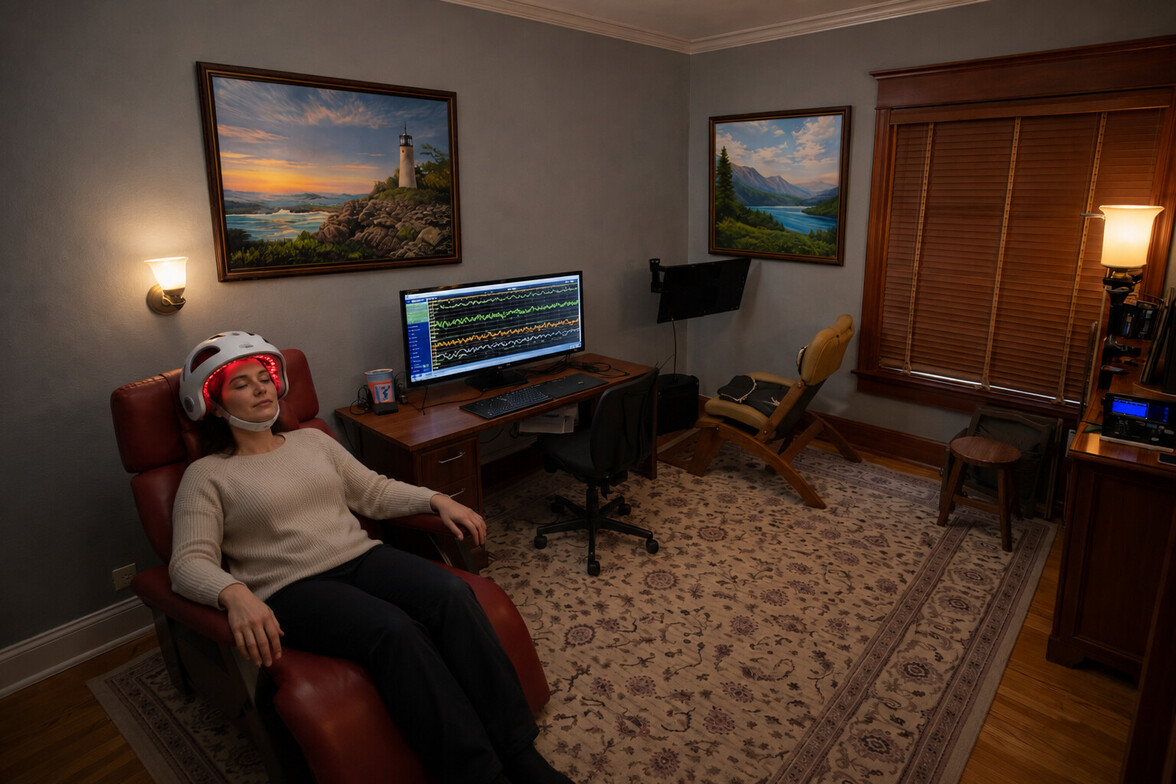
Photobiomodulation (PBM) is a non-invasive therapy that uses near-infrared light to support healthy brain function.
Unlike ultraviolet light, PBM does not damage tissue or produce heat. Instead, specific wavelengths of light pass through the scalp and are absorbed by brain cells.
The light stimulates tiny structures inside the cells called mitochondria, which are responsible for producing cellular energy.
When brain cells have more energy available, they may function more efficiently and communicate more effectively.
Researchers are studying PBM for its potential to support:
• Brain fog
• Memory concerns
• Difficulty concentrating
• Concussion recovery
• Healthy aging
• Cognitive performance
• Migraine
• Depression
• Anxiety
• Sleep quality
How Can Light Help the Brain?
Healthy brain cells require enormous amounts of energy.
When that energy production decreases because of injury, aging, inflammation, illness, or chronic stress, brain function may also decline.
Photobiomodulation is thought to help by supporting:
• Cellular energy production
• Healthy blood flow
• Oxygen delivery
• Normal inflammatory responses
• Neuroplasticity, the brain's ability to adapt and form new connections
While researchers continue to study these mechanisms, the growing body of evidence suggests PBM may help support the brain's natural healing processes.
Is PBM Right for Everyone?
No.
Photobiomodulation is not a cure for every neurological condition, and it is not a replacement for appropriate medical evaluation.
Symptoms like brain fog, memory loss, poor concentration, or chronic fatigue can have many underlying causes that should be properly assessed.
In many cases, the best outcomes occur when PBM is part of a comprehensive approach that may include functional medicine testing, nutritional support, sleep optimization, exercise, stress management, neurofeedback, and treatment of any underlying medical conditions.
Can Brain Mapping Help?
Every brain is unique.
Rather than using the same protocol for everyone, many practitioners use quantitative electroencephalography (QEEG) to better understand how an individual's brain is functioning.
A QEEG measures patterns of brain activity and can help identify areas that may not be functioning optimally.
This information may be used to personalize therapies such as photobiomodulation and neurofeedback instead of relying on a one-size-fits-all approach.
The Bottom Line
If you've been searching for answers to questions like:
"Why do I have brain fog?"
"Why can't I focus?"
"Why is my memory getting worse?"
"Why am I mentally exhausted all the time?"
or
"How can I recover from a concussion?"
you deserve more than a temporary solution.
Understanding why your brain isn't functioning at its best is the first step. For some people, photobiomodulation may become one piece of a personalized plan to support healthier brain function, improved cognitive performance, and better quality of life.
Janell Matz
Contact Me