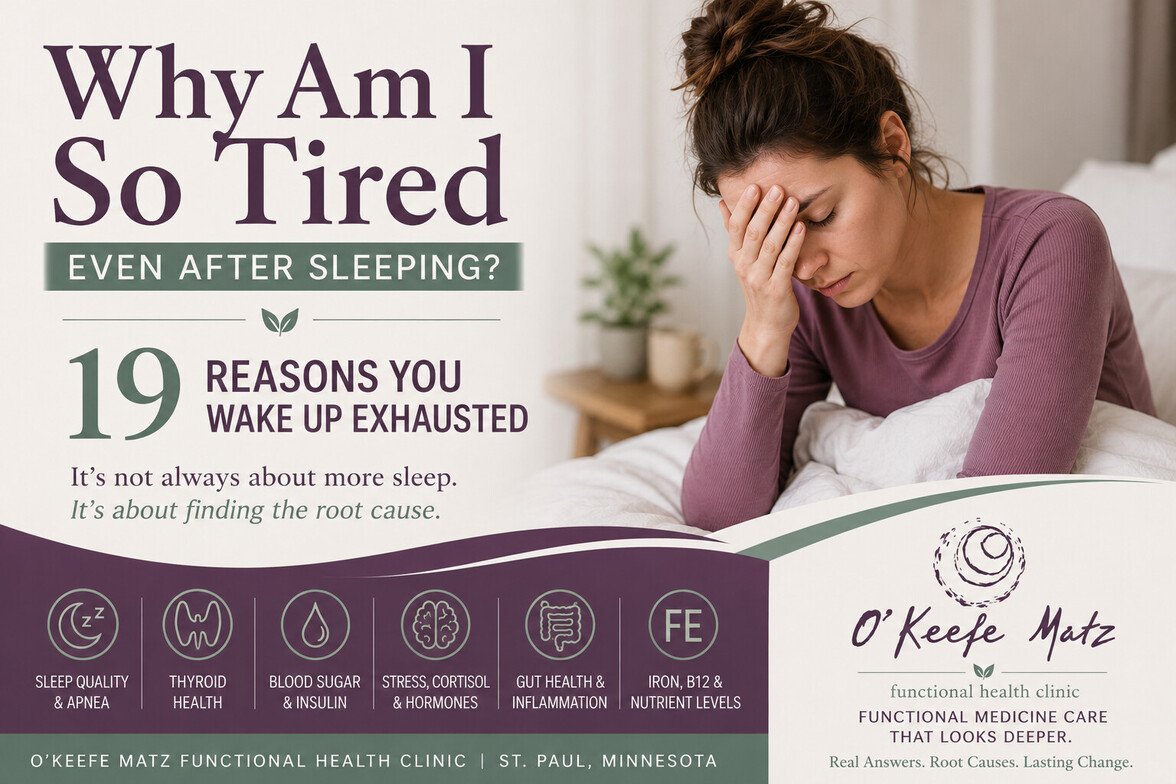
Why Am I So Tired Even After Sleeping? 19 Reasons You Wake Up Exhausted
You went to bed at a reasonable time.
You slept seven, eight, maybe even nine hours.
But when the alarm goes off, you feel like you barely slept at all.
You drag yourself out of bed. You need coffee to function. Your brain feels foggy. By midmorning or early afternoon, you are already thinking about when you can lie down again.
If this sounds familiar, you may have asked yourself:
Why am I so tired even after sleeping?
The answer may not be that you need more sleep.
Sometimes, persistent fatigue is a sign that your body is struggling with something deeper.
At O'Keefe Matz Functional Health Clinic in St. Paul, Minnesota, we frequently work with people who say the same thing:
"I'm sleeping, but I never feel rested."
Here are 19 possible reasons why.
1. Your Sleep Quality May Be Poor
There is a major difference between being unconscious for eight hours and getting eight hours of restorative sleep.
Your brain and body move through different stages of sleep throughout the night. Deep sleep and REM sleep are especially important for physical repair, memory, hormone regulation, immune function, and brain health.
You may be in bed for eight hours but repeatedly moving into lighter stages of sleep without realizing it.
Frequent micro-awakenings, pain, stress, breathing problems, alcohol, blood sugar fluctuations, medications, and nervous system dysregulation can all interfere with restorative sleep.
2. Your Thyroid May Not Be Functioning Optimally
Fatigue is one of the most common symptoms associated with low thyroid function.
Other symptoms may include:
Cold hands and feet
Weight gain or difficulty losing weight
Constipation
Dry skin
Hair thinning
Brain fog
Low mood
Muscle weakness
Elevated cholesterol
Many people are told their thyroid is "normal" because their TSH falls within the standard laboratory reference range.
But TSH is only one piece of the thyroid picture.
A more comprehensive thyroid evaluation may include TSH, free T3, free T4, thyroid peroxidase antibodies, and thyroglobulin antibodies.
This can be especially important when evaluating for Hashimoto's thyroiditis, an autoimmune condition that affects the thyroid.
3. Your Iron or Ferritin May Be Low
You do not necessarily have to be anemic to experience fatigue related to iron status.
Ferritin reflects your body's stored iron.
Some people have a normal hemoglobin level but low or suboptimal ferritin levels and still experience significant fatigue.
Symptoms may include:
Exhaustion
Weakness
Shortness of breath with activity
Heart palpitations
Headaches
Hair loss
Restless legs
Feeling cold
A complete iron evaluation may include serum iron, ferritin, total iron-binding capacity, and iron saturation.
4. Your Blood Sugar May Be Unstable
Blood sugar problems do not begin the day someone is diagnosed with diabetes.
Years before that diagnosis, the body may struggle with blood sugar regulation and insulin resistance.
You may notice:
Fatigue after meals
Afternoon crashes
Sugar cravings
Feeling shaky when you have not eaten
Waking during the night
Difficulty concentrating
Weight gain around the abdomen
Needing caffeine to keep going
Fasting glucose alone may not tell the entire story.
Hemoglobin A1c and fasting insulin can provide additional information about how your body is managing glucose.
5. You May Have Insulin Resistance
Insulin resistance occurs when your cells become less responsive to insulin.
Your pancreas may compensate by producing more insulin.
Blood glucose can remain within the standard range for quite some time while insulin levels are already elevated.
This means someone can be told their blood sugar is "normal" while their metabolism is working increasingly hard to maintain that number.
Fatigue, weight gain, increased hunger, carbohydrate cravings, and difficulty losing weight can sometimes be associated with insulin resistance.
6. Your Cortisol Rhythm May Be Disrupted
Cortisol is often called the stress hormone, but cortisol is essential for normal health.
Ideally, cortisol should follow a daily rhythm.
It should rise in the morning to help you wake up and gradually decrease throughout the day so your body can prepare for sleep.
When this rhythm becomes disrupted, you may feel:
Exhausted in the morning
Dependent on caffeine
Tired during the day
Wired at night
Unable to fall asleep
Awake between 2:00 and 4:00 a.m.
Overwhelmed by normal stress
Testing cortisol at multiple points throughout the day may provide more information than looking at a single morning cortisol level.
7. Chronic Stress May Be Keeping Your Nervous System on Alert
You may be physically tired while your nervous system remains on high alert.
Long-term stress can affect sleep, digestion, blood sugar regulation, muscle tension, hormone signaling, and immune function.
Some people describe feeling both tired and wired.
Your body is exhausted, but your brain will not shut off.
You may clench your jaw, tighten your shoulders, wake easily, have vivid dreams, or feel like you are constantly anticipating the next problem.
When the nervous system has difficulty shifting into a restorative state, sleep may not feel refreshing.
8. You May Have Sleep Apnea
Sleep apnea can cause repeated interruptions in breathing throughout the night.
You may not remember waking up.
Your brain, however, repeatedly moves out of deeper sleep to restore normal breathing.
Possible symptoms include:
Loud snoring
Morning headaches
Dry mouth
Daytime fatigue
Brain fog
Difficulty concentrating
Waking up gasping
High blood pressure
Falling asleep while watching television
Sleep apnea can occur in people of many different body types and should not be ruled out based solely on weight.
9. Menopause or Hormone Changes May Be Affecting Your Sleep
Hormonal changes during perimenopause and menopause can significantly affect sleep quality.
Changes in estrogen and progesterone may contribute to:
Night sweats
Hot flashes
Frequent waking
Anxiety
Heart palpitations
Changes in mood
Difficulty falling asleep
Early morning waking
Women often describe suddenly becoming poor sleepers despite having slept well for most of their lives.
Hormonal changes can also interact with thyroid function, blood sugar regulation, stress hormones, and inflammation.
10. Vitamin B12 or Folate May Be Low
Vitamin B12 and folate are important for red blood cell production, neurological function, and energy metabolism.
Low levels may contribute to:
Fatigue
Weakness
Brain fog
Numbness or tingling
Balance problems
Memory difficulties
Mood changes
Some people may have difficulty absorbing B12 because of gastrointestinal problems, medications, autoimmune conditions, or changes in stomach acid.
11. Your Vitamin D May Be Low
Vitamin D plays a role in immune function, bone health, muscle function, and inflammation.
Low vitamin D levels are common, particularly in northern climates such as Minnesota.
Fatigue, muscle weakness, low mood, and frequent illness may sometimes be associated with low vitamin D status.
Testing can help determine whether supplementation is appropriate and how much may be needed.
12. Chronic Inflammation May Be Draining Your Energy
Inflammation requires energy.
When your immune system remains activated for extended periods of time, fatigue can be one of the body's signals that something is wrong.
Inflammation may be associated with:
Autoimmune disease
Blood sugar problems
Chronic infections
Gut dysfunction
Poor sleep
Obesity
Environmental exposures
Chronic stress
Inflammatory markers such as high-sensitivity C-reactive protein may provide useful information when interpreted alongside symptoms and other laboratory findings.
13. Your Gut May Be Affecting Your Energy
The gastrointestinal system does much more than digest food.
It is involved in nutrient absorption, immune function, inflammation, and communication with the brain.
Digestive problems such as bloating, constipation, diarrhea, reflux, or abdominal discomfort may be clues that gastrointestinal function needs further evaluation.
Conditions such as small intestinal bacterial overgrowth, intestinal inflammation, digestive insufficiency, or altered gut bacteria may affect nutrient absorption and contribute to fatigue.
Depending on the person's history, more comprehensive gastrointestinal testing may be considered.
14. You May Not Be Absorbing Nutrients Properly
You can eat a healthy diet and still struggle with nutrient deficiencies.
Why?
Because eating nutrients and absorbing nutrients are not the same thing.
Low stomach acid, gastrointestinal inflammation, celiac disease, digestive enzyme insufficiency, bacterial overgrowth, and other digestive problems may interfere with nutrient absorption.
Iron, B12, folate, magnesium, and other nutrients are essential for normal energy production.
15. Your Mitochondria May Be Struggling to Produce Energy
Mitochondria are often described as the powerhouses of the cells.
Their job is to help convert nutrients into usable cellular energy.
When mitochondrial function is impaired, people may describe profound fatigue, poor exercise tolerance, slow recovery, and feeling physically depleted after activities that previously felt easy.
Oxidative stress, inflammation, nutrient deficiencies, metabolic dysfunction, and environmental factors may influence mitochondrial function.
16. Your Medication May Be Contributing to Fatigue
Fatigue can be a side effect of many medications.
These may include certain:
Antidepressants
Antihistamines
Blood pressure medications
Muscle relaxants
Anti-anxiety medications
Pain medications
Sleep medications
It is important not to stop prescription medication without speaking with the prescribing provider.
However, reviewing your medications and discussing fatigue with your healthcare team may help identify potential contributors.
17. Alcohol May Be Disrupting Your Sleep More Than You Realize
Alcohol may help you fall asleep faster.
Unfortunately, it can also interfere with sleep quality later in the night.
Alcohol may fragment sleep, reduce restorative sleep, worsen snoring, and contribute to early morning waking.
Some people do not connect their evening glass of wine or cocktail with their morning fatigue because they fall asleep easily.
The problem may be what happens several hours later.
18. Histamine May Be Affecting Your Sleep
Histamine is involved in immune function, digestion, and wakefulness.
For some people, problems with histamine regulation may contribute to:
Difficulty sleeping
Heart racing
Flushing
Headaches
Nasal congestion
Itching
Digestive symptoms
Feeling wired at night
Histamine-related symptoms can be complex and may overlap with allergies, gastrointestinal dysfunction, hormonal changes, and other conditions.
19. Your Body May Be Dealing With More Than One Problem
This is incredibly common.
You may have low ferritin and thyroid dysfunction.
You may be in perimenopause and experiencing blood sugar instability.
You may have chronic stress and gastrointestinal dysfunction.
You may have sleep apnea and low vitamin D.
The body does not separate itself into individual departments.
Your thyroid communicates with your brain.
Your brain communicates with your gut.
Your gut interacts with your immune system.
Your stress response affects your hormones, blood sugar, digestion, and sleep.
This is why persistent fatigue often requires looking at the entire pattern rather than searching for one abnormal laboratory number.
"My Blood Tests Were Normal. Why Am I Still So Tired?"
We hear this frequently.
A patient goes to the doctor because they are exhausted.
Basic laboratory testing is performed.
They receive a message saying:
"Everything looks normal."
But they still feel terrible.
This does not mean that laboratory testing is useless.
It means that the testing performed may not have answered the question you are asking.
A basic CBC, comprehensive metabolic panel, and TSH can provide important health information.
But depending on your symptoms and health history, additional evaluation may be appropriate.
This might include a more comprehensive look at:
Thyroid function and thyroid antibodies
Iron and ferritin
Vitamin B12 and folate
Vitamin D
Fasting insulin
Hemoglobin A1c
Inflammatory markers
Advanced cardiovascular markers
Hormone patterns
Cortisol rhythm
Gastrointestinal function
Nutrient status
The goal is not to order every test available.
The goal is to ask better questions and select testing based on your symptoms, health history, and individual pattern.
The Answer May Not Be More Sleep
If you are sleeping seven, eight, or even nine hours and still waking up exhausted, the answer may not be going to bed earlier.
The next step may be figuring out why your body is not restoring itself overnight.
Persistent fatigue is a symptom.
The question is:
What is driving it?
A Functional Medicine Approach to Chronic Fatigue in St. Paul, Minnesota
At O'Keefe Matz Functional Health Clinic, Dr. Shannon O'Keefe works with patients who have often been struggling with fatigue, brain fog, thyroid symptoms, hormone changes, digestive problems, and other chronic health concerns for years.
Dr. O'Keefe is a chiropractic physician and Board Certified Clinical Nutritionist with decades of experience in healthcare and clinical nutrition.
Her approach is scientific, thorough, and highly individualized.
Rather than simply asking, "What can we give you for fatigue?" she asks a different question:
"Why are you tired?"
That may require looking more closely at thyroid function, including Hashimoto's thyroiditis, insulin and glucose regulation, iron and ferritin, nutrient deficiencies, inflammation, hormone changes, cortisol patterns, gastrointestinal health, and other factors that may be affecting the body's ability to produce energy and recover.
Dr. O'Keefe is particularly passionate about working with complex cases.
These are often patients who know something is wrong but have struggled to find an explanation for why they feel the way they do.
Functional medicine does not replace appropriate conventional medical care.
Instead, it can provide another way of investigating persistent symptoms by looking at patterns, relationships, and potential contributing factors.
Are You Tired of Being Tired?
If you wake up exhausted despite getting enough sleep, struggle with afternoon crashes, rely on caffeine to function, or feel like your energy has slowly disappeared, it may be time to look deeper.
Dr. Shannon O'Keefe offers a complimentary 15-minute phone consultation to discuss your symptoms, health history, and whether a functional medicine approach may be appropriate for you.
O'Keefe Matz Functional Health Clinic is located in St. Paul, Minnesota and works with patients seeking a more comprehensive approach to fatigue, thyroid concerns, Hashimoto's, menopause, digestive problems, and chronic health symptoms.
You may not need more sleep.
You may need better answers.