Anxiety isn't just feeling stressed. For many people, it's a persistent hum in the background of everyday life — the racing thoughts at 2am, the tight chest before an ordinary conversation, the sense that your nervous system is stuck on high alert no matter how much you try to relax.
If that sounds familiar, you've probably already tried the usual suggestions: breathe more, sleep better, cut the caffeine. And maybe some of those help, a little, sometimes. But for a lot of people with anxiety, the issue isn't a habit — it's how the brain itself is functioning. That's exactly where neurofeedback for anxiety comes in.
What Is Neurofeedback, and Why Does It Matter for Anxiety?
Neurofeedback is a type of brain training that works by measuring your brainwave activity in real time and giving your nervous system moment-to-moment feedback — essentially teaching the brain to self-regulate more effectively.
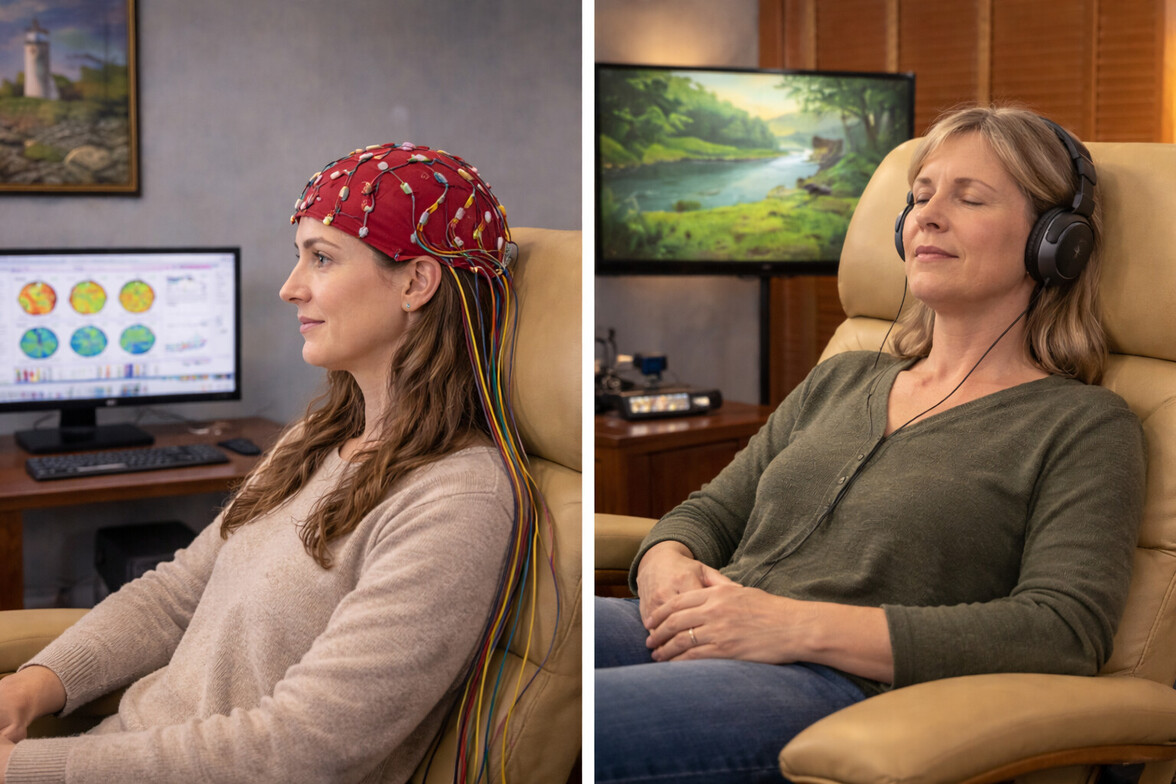
Here's the simple version: sensors placed on your scalp detect your brainwave patterns while you watch a screen or listen to audio. When your brain produces calmer, more balanced activity, the program rewards it. When it drifts into anxious or dysregulated patterns, the feedback shifts. Over time, the brain learns — on its own — to spend more time in the more balanced state.
It's not relaxation training. It's not talk therapy. It's neurological retraining at the source.
Research published in Applied Psychophysiology and Biofeedback has shown that neurofeedback therapy for anxiety can meaningfully reduce symptoms, with effects that persist well after treatment ends — something that can be harder to achieve with medication alone.
What Happens in the Anxious Brain?
To understand why neurofeedback works for anxiety, it helps to understand what's actually happening neurologically.
Anxiety is often associated with excess high-frequency brainwave activity — particularly beta waves — especially in areas of the brain linked to threat detection and emotional processing. When the brain gets locked into these fast, reactive patterns, it can feel almost impossible to downshift. You might know intellectually that you're safe, but your nervous system hasn't gotten the message.
At the same time, many people with anxiety also show insufficient alpha wave activity — the calm, grounded state the brain needs to transition out of stress responses. This imbalance between high beta and low alpha is a pattern neurofeedback practitioners know well, and it's one the training is specifically designed to address.
At O'Keefe Matz Chiropractic & Functional Health Clinic in Saint Paul, Dr. Janell Matz uses advanced QEEG brain mapping (a quantitative EEG, sometimes called a "brain map") to identify each patient's specific dysregulation patterns before any neurofeedback sessions begin. That means the training isn't generic — it's targeted to what's actually happening in your brain.
What Does Neurofeedback Anxiety Treatment Feel Like?
One of the most common questions people ask is: "does neurofeedback work for anxiety, and will I actually notice a difference?"
The honest answer: most patients don't notice a dramatic shift in any single session. Neurofeedback is a process, not a procedure. The changes tend to be cumulative — patients often describe it as gradually feeling less reactive, sleeping more deeply, or noticing that situations that used to trigger a full anxiety spiral now feel more manageable.
Sessions themselves are typically calm and fairly passive. You sit comfortably, sensors are placed on your scalp, and you watch a video or listen to audio while the software monitors and responds to your brainwave activity. Most sessions run 30–45 minutes. There's no medication involved and no discomfort.
The number of sessions needed varies by person and by severity. Dr. Matz develops individualized protocols based on your QEEG results and your specific symptoms — whether that's generalized anxiety, panic, social anxiety, or anxiety layered on top of other conditions like insomnia or ADHD.
How Neurofeedback Fits Into a Whole-Person Approach
Something that makes care at O'Keefe Matz genuinely different is that neurofeedback doesn't exist in isolation. Anxiety rarely does either — it often shows up alongside disrupted sleep, hormonal imbalances, gut issues, or chronic tension in the body. Dr. Matz's training spans chiropractic care, functional medicine, acupuncture, and clinical nutrition, which means she can look at the full picture rather than just one piece of it.
For some patients, neurofeedback is the primary tool. For others, it's part of a broader plan that might include functional lab work to check on thyroid or adrenal function, nutritional support to address nervous system deficiencies, or chiropractic adjustments that reduce the physical tension component of anxiety.
The Anxiety and Depression Association of America notes that anxiety disorders are among the most common mental health conditions in the US — and yet many people never find lasting relief because treatment targets only symptoms rather than underlying causes. An integrative approach that includes neurofeedback is one way to go deeper.
Is Neurofeedback Right for You?
Neurofeedback tends to be a strong fit for people who:
- Have tried medication and found it helps only partially, or come with side effects they'd rather avoid
- Are looking for a non-pharmaceutical approach to anxiety management
- Have anxiety layered with other concerns like insomnia, ADHD, depression, or concussion history
- Want to understand *why* their nervous system functions the way it does — not just manage symptoms
It's also worth knowing that neurofeedback isn't a quick fix, and it isn't the right fit for everyone. That's why the evaluation process at O'Keefe Matz starts with a thorough intake and, often, a QEEG assessment — so you have real information before committing to a protocol.
Take the Next Step
If you've been living with anxiety and haven't found something that really shifts it, neurofeedback therapy for anxiety may be worth exploring. The team at O'Keefe Matz Functional Health Clinic in Saint Paul works with patients who are ready to look beyond surface-level symptom management and get to what's actually driving their symptoms.
You can learn more about our neurofeedback approach and what a first visit looks like — or reach out to schedule a consultation. We're here when you're ready.